
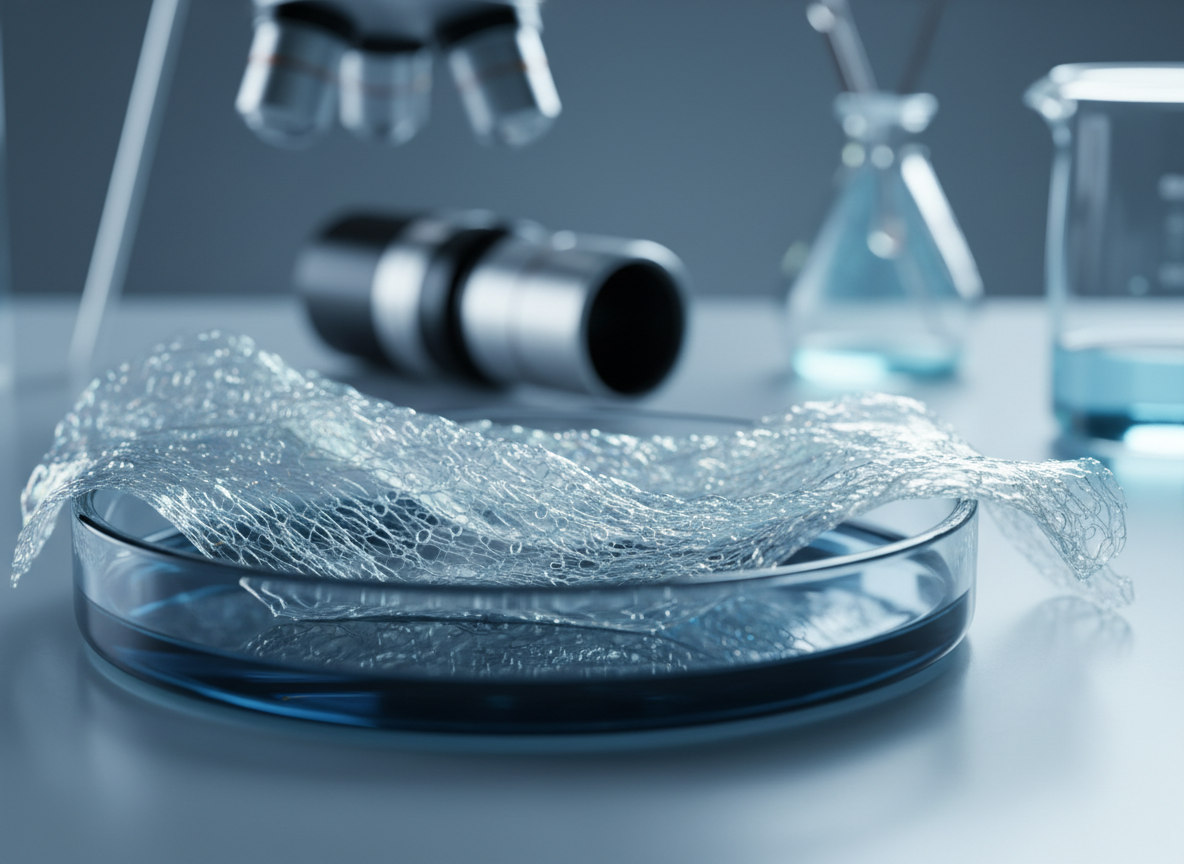
What Is a Collagen Membrane in Dental Surgery?
A collagen membrane is a resorbable barrier used in dental surgery to guide tissue regeneration and protect bone grafts during healing. In UK dental clinics, these membranes are now standard in many implant and periodontal procedures. They help create a stable environment for new bone and soft tissue to form, while keeping faster-growing cells away from the defect site.
What does a collagen membrane do?
A collagen membrane acts as a selective barrier between different tissue types. Its main job is to prevent fast-growing epithelial and connective tissue cells from invading a bone defect or graft site. As a result, slower-growing osteogenic cells get the space and time they need to regenerate bone.
In addition, the membrane stabilises the blood clot and protects the wound from bacterial contamination. This is especially important in guided bone regeneration (GBR) and guided tissue regeneration (GTR) procedures. For example, after an extraction or around an implant, the membrane helps maintain the volume of the ridge and supports predictable healing.
How does a collagen membrane work in guided bone regeneration?
Guided bone regeneration relies on creating a protected space where bone can regrow. A collagen membrane is placed over the graft material or defect to isolate it from the surrounding soft tissue.
Read More: Composite Bonding vs. Veneers: What’s Best for Your Smile?
The membrane performs three key functions:
- Barrier function: It blocks fibroblasts and epithelial cells from migrating into the defect.
- Scaffold function: It supports cell attachment and vascular ingrowth from the base of the defect.
- Stabilisation function: It helps hold the graft in place and protects the clot during early healing.
In practice, this means better bone fill, improved ridge dimensions and more predictable implant placement later on.
What types of collagen membranes are available?
Not all collagen membranes are the same. They differ in source, structure, cross-linking and resorption time. Most membranes used in UK clinics are derived from porcine or bovine collagen, typically type I or a mix of type I and III.
Common categories include:
- Native collagen membranes: Minimally processed, resorb relatively quickly (around 4–8 weeks).
- Cross-linked collagen membranes: Chemically or physically cross-linked to slow degradation (often 12–24 weeks or more).
- Double-layer membranes: One dense layer faces the soft tissue, while a more porous layer faces the bone to support cell ingrowth.
In addition, some newer membranes incorporate antimicrobial agents such as silver nanoparticles to reduce infection risk in contaminated sites. However, these are still emerging in routine UK practice.
When should you use a collagen membrane in implant therapy?
A collagen membrane is indicated whenever you need to preserve or augment bone volume around implants. Typical scenarios in UK implant dentistry include:
- Socket preservation after extraction, especially in the aesthetic zone.
- Lateral ridge augmentation where horizontal bone width is insufficient.
- Vertical bone augmentation in combination with particulate grafts or blocks.
- Peri-implant defect coverage to protect grafts around exposed implant threads.
Evidence shows that using a resorbable collagen membrane with a bone substitute reduces post-extraction ridge resorption. Systematic reviews report around 1.8–2.3 mm less horizontal and vertical bone loss compared with spontaneous healing. For many clinicians, this difference is clinically significant when planning anterior implants.
How is a collagen membrane used in periodontal regeneration?
In periodontics, a collagen membrane is a core component of guided tissue regeneration (GTR). It is used to treat intrabony defects, furcation lesions and some recession cases.
The membrane is placed over the cleaned defect after debridement, often with a bone graft or biologics. Its role is to exclude epithelial downgrowth and allow periodontal ligament cells to repopulate the root surface. Studies have shown that GTR with collagen membranes can achieve:
- Probing depth reductions of 3–4 mm in deep intrabony defects.
- Clinical attachment level gains of around 1–2 mm compared with open flap debridement alone.
- Improved bone fills in suitable defect morphologies.
In addition, collagen membranes are used to cover extraction sockets in periodontally compromised patients to support soft tissue healing and reduce post-operative bleeding.
What are the advantages of resorbable collagen membranes?
Resorbable collagen membranes have largely replaced non-resorbable options such as e-PTFE in many UK clinics. The main advantages include:
- No second surgery: The membrane degrades naturally, so there is no need for removal.
- Biocompatibility: Collagen is well tolerated and supports cell attachment.
- Haemostatic properties: Collagen helps stabilise the clot and control bleeding.
- Ease of handling: Membranes can be trimmed, shaped and adapted to complex defects.
However, clinicians must still respect the biological limits of each membrane. Faster-resorbing membranes may not provide enough barrier time in large vertical augmentations, while highly cross-linked membranes may persist longer than desired in shallow defects.
How do you choose the right collagen membrane for a case?
Selecting the right collagen membrane depends on the defect type, required barrier time and soft tissue conditions. A few practical points can help:
- For socket preservation and small horizontal defects, a native or lightly cross-linked membrane is often sufficient.
- For vertical ridge augmentation or large defects, a more stable, cross-linked membrane with longer resorption time is preferable.
- In areas with thin soft tissue or high tension, a thicker, double-layer membrane can improve stability and reduce the risk of early exposure.
In addition, consider the need for primary closure. If tension-free closure is doubtful, a more robust membrane and careful flap design become critical. Some clinicians also combine membranes with soft tissue grafts or collagen matrices to improve the quality of the overlying mucosa.
What are the common pitfalls and how can you avoid them?
Even with a high-quality collagen membrane, complications can occur if surgical technique is suboptimal. Common issues include:
- Early membrane exposure: Often due to inadequate flap advancement or excessive tension.
- Infection: Particularly in contaminated extraction sockets or poorly debrided periodontal defects.
- Membrane collapse: When the membrane is not properly supported by graft material or underlying bone.
To minimise these risks, ensure meticulous debridement, achieve tension-free primary closure and use appropriate graft support. In addition, give clear post-operative instructions and consider chlorhexidine rinses where appropriate.
What does the evidence say about collagen membranes in UK practice?
Systematic reviews and clinical trials support the use of collagen membrane in both GBR and GTR. In implant dentistry, membranes combined with bone substitutes consistently show better ridge preservation and bone gain than spontaneous healing. In periodontics, collagen membranes deliver improvements in probing depth, attachment level and bone fill compared with open flap surgery alone.
Read More: Why Choose a Private Dentist in Manchester for Your Smile?
For UK dental clinics, this translates into more predictable outcomes, fewer complications and better long-term stability of implants and periodontally treated teeth. When used correctly, a collagen membrane is not just an adjunct: it is a core element of modern regenerative dentistry.
Conclusion
A collagen membrane is a resorbable barrier that plays a central role in guided bone and tissue regeneration. It protects grafts, stabilises clots and creates the space needed for new bone and periodontal tissues to form. For UK dentists working in implant and periodontal therapy, understanding the different types, indications and handling techniques is essential.
Used thoughtfully, a collagen membrane can improve healing, reduce complications and enhance the predictability of complex regenerative procedures.
